 Seoul City Guide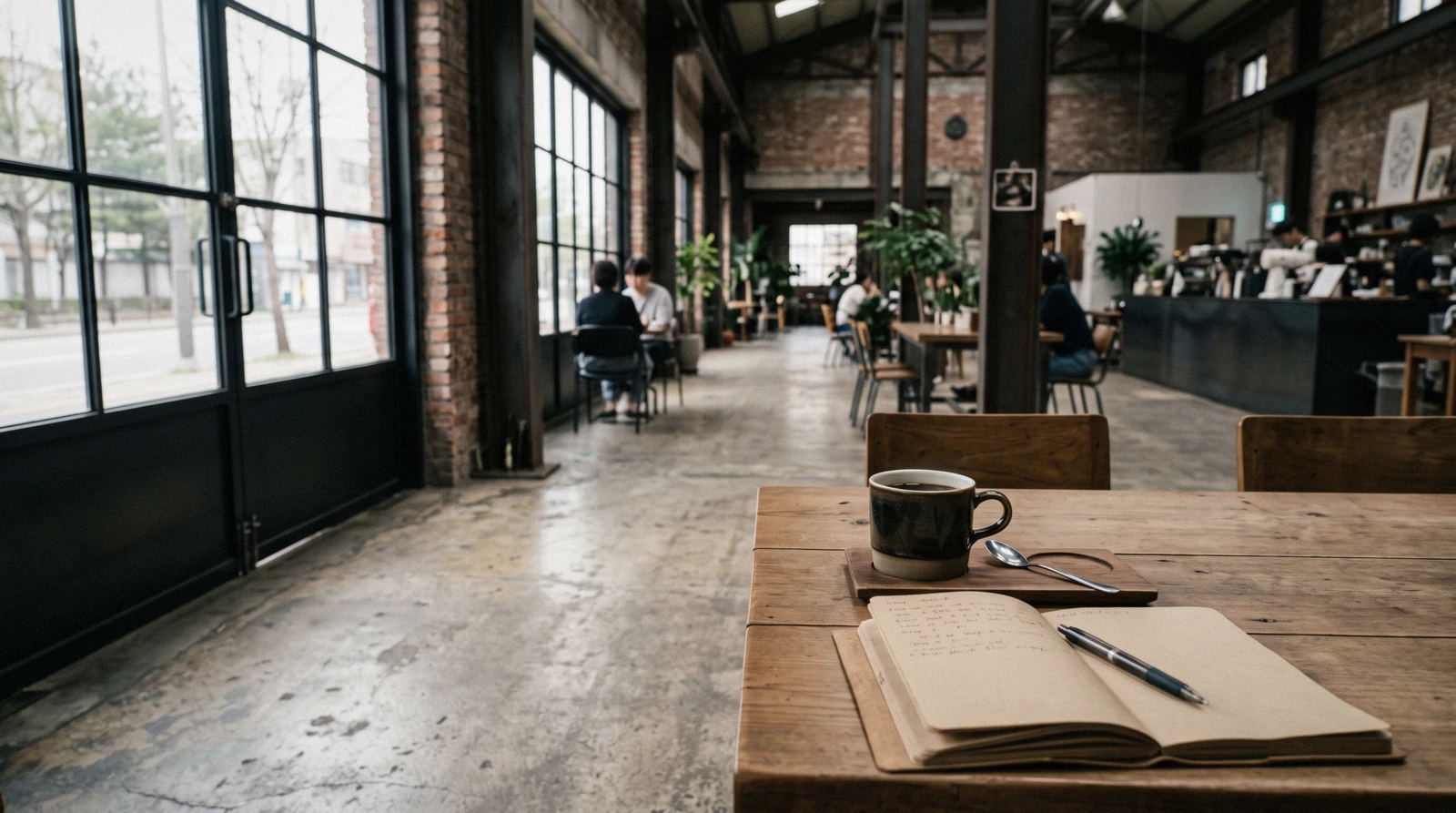
Cafés in Seoul: What You Are Actually Paying For
The best cafes Seoul has are not selling coffee, they are selling a room — which is why a filter coffee costs ₩6,000 in Seongsu and why nobody minds you sitting in it for three hours. This page covers the districts, the prices and the conventions. The rest of the eating is on the where to eat page and the trip on one of the guided tours in Seoul. A café stop fits between most things to do in Seoul, since the busiest café districts sit beside the palaces and markets.
Quick answer ₩6,000 for coffee, and the room is the point
Seoul has more cafés per head than almost anywhere, and the good ones are architectural projects with an espresso machine in them: converted factories, hanok courtyards under glass, concrete boxes with one perfect window. Coffee runs ₩4,500 at a chain to ₩8,000 in the fashionable districts, and the convention is that you may sit as long as you like.
Key takeaways
- Seongsu for the converted-factory version, Ikseon-dong for hanok courtyards, Hongdae and Yeonnam for the student version.
- Nobody will move you on. Two or three hours with one drink is standard, and sockets and wi-fi are assumed.
- This is a daytime culture — most independents shut by ten and there is no café equivalent of a late bar.
Which District, and What It Costs
The café districts a visitor will actually use, with the going rate for a filter coffee and what the rooms are like, checked in Q3 2026.
| District | Coffee | The style | Best time |
|---|---|---|---|
| Seongsu | ₩6,000–₩8,000 | Converted shoe factories, concrete and steel | Weekday morning |
| Ikseon-dong | ₩5,000–₩7,000 | Hanok courtyards glassed over | Weekday afternoon |
| Yeonnam and Hongdae | ₩5,000–₩7,000 | Small, student-priced, dense | Any afternoon |
| Hannam and Itaewon | ₩7,000+ | Gallery-adjacent, expensive, quiet | Weekday |
| Insadong | ₩8,000–₩12,000 a pot | Traditional tea houses, not coffee | After a palace |
| Chains everywhere | ₩3,000–₩5,500 | Reliable, air-conditioned, everywhere | When it rains |
Insadong's tea houses are a different institution: infusions rather than coffee, ₩8,000 to ₩12,000 a pot, served with a sweet, and an hour is the expected stay.
Why Coffee Costs What It Does
Two structural reasons, and neither is the beans.
Rent. A café in Seongsu or Hannam pays for a location that is itself the product, and the fit-out — the concrete, the steel window frames, the single perfect tree in the courtyard — is capital that has to come back through the cup.
Dwell time. If the business model assumes a customer occupies a seat for two hours, the drink has to carry two hours of that seat. Korean café culture is built on staying: students revise, freelancers work, friends talk, and nobody hurries anyone. A ₩6,000 coffee for three hours of a well-designed room with wi-fi and a socket is, on that arithmetic, cheap.
The low-cost chains exist for the opposite need — ₩3,000, a quick cup, high turnover — and are everywhere.
One consequence worth knowing: the photograph is part of the product. Some of the most popular cafés in Seoul are better rooms than they are coffee, and the queue outside one at the weekend is not a verdict on the espresso.
The Conventions
Order at the counter, pay first, take a buzzer. Table service is rare outside hotel cafés.
Water is free and self-service, usually from a dispenser near the counter.
Staying is expected. There is no time limit in an ordinary café, though a handful of small places post a two-hour limit at weekends, and study cafés — a separate category, rented by the hour — exist for people who want a desk rather than a table.
Wi-fi and sockets are assumed. Passwords are on the receipt or the wall.
Tipping does not happen. Nor anywhere else in Korea.
Dessert is a course. Korean café menus put as much effort into cakes, bingsu shaved ice and croissants as into the coffee, and in summer a bowl of bingsu shared between two is a meal in itself.
Pet cafés, book cafés and themed cafés are a genuine category rather than a novelty, and they are concentrated in Hongdae.
Where the Cafés Are
Three districts, three different afternoons.
Seongsu-dong
Converted factories and flagship stores: Seongsu.
- Coffee ₩6,000–₩8,000
- 11:00–19:00
- Weekday mornings are empty
Ikseon-dong
Hanok courtyards you can sit inside: Ikseon-dong.
- Coffee ₩5,000–₩7,000
- No visitor curfew
- Best in the evening
Insadong
Traditional tea houses instead of coffee: Insadong.
- ₩8,000–₩12,000 a pot
- Alleys, not the main street
- An hour is normal
Café Questions
How much is coffee in Seoul?
Can I sit in a Seoul café for hours?
Yes, and it is expected. Two or three hours with one drink is normal, wi-fi and sockets are standard, and only a handful of small places post weekend time limits.
Which area has the best cafés in Seoul?
Seongsu for converted-factory design, Ikseon-dong for hanok courtyards, Yeonnam and Hongdae for the student-priced version, Hannam for the expensive one.
Do Seoul cafés open early?
Mostly not. Independents open around 11:00 and close by 21:00 or 22:00. For an early coffee, the chains open from seven.
What is a study café?
A separate category rented by the hour, with desks, silence and no obligation to buy anything. Ordinary cafés tolerate laptops; study cafés are built for them.
Is bingsu worth trying?
In summer, yes. Shaved milk ice with red bean, fruit or matcha, served in a bowl meant for two, and it functions as a meal rather than a dessert.
Café Seoul on Video
The rooms this page describes, filmed.
This is Seoul’s Trendiest Neighborhood Right Now! | Seongsu 🇰🇷 Full Tour
Video: David J RobbinsWhat to do Seongsu dong Seoul - A 1st timers guide to Korea ’s Coolest Neighborhood!
Video: PhatLife ProjectCoolest Neighborhood in Seoul: Exploring Seongsu’s Best Spots
Video: Joon BugVideos are other people's work, embedded for context; nothing here is sponsored.
Prices, hours and terms are set by the venue or operator and confirmed at checkout.
We may earn a commission if you book through one of our links, at no extra cost to you. Full affiliate disclosure